
Material, memories & room fit
Wooden Map vs Push-Pin Map: Choose Your Travel Tracker
Choose a wooden map for a layered travel feature, provided its detail and accessories suit how you mark trips. Compare appearance, tracking, installation and the complete display before choosing.
The short answer
Is the map a sculptural display or a detailed travel record?
Choose a wooden map for a layered travel feature, provided its detail and accessories suit how you mark trips. Choose a printed push-pin map when a continuous surface, city labels and a clear visited/planned legend are the priority. Pins describe a tracking method: wooden, paper and canvas maps can all support them in the right construction.
A display where the shape and finish of the landmasses matter as much as the markers.
A continuous printed map with compatible backing, fine location detail and a flexible pin legend.
See the difference
Two ways to put your world on the wall.
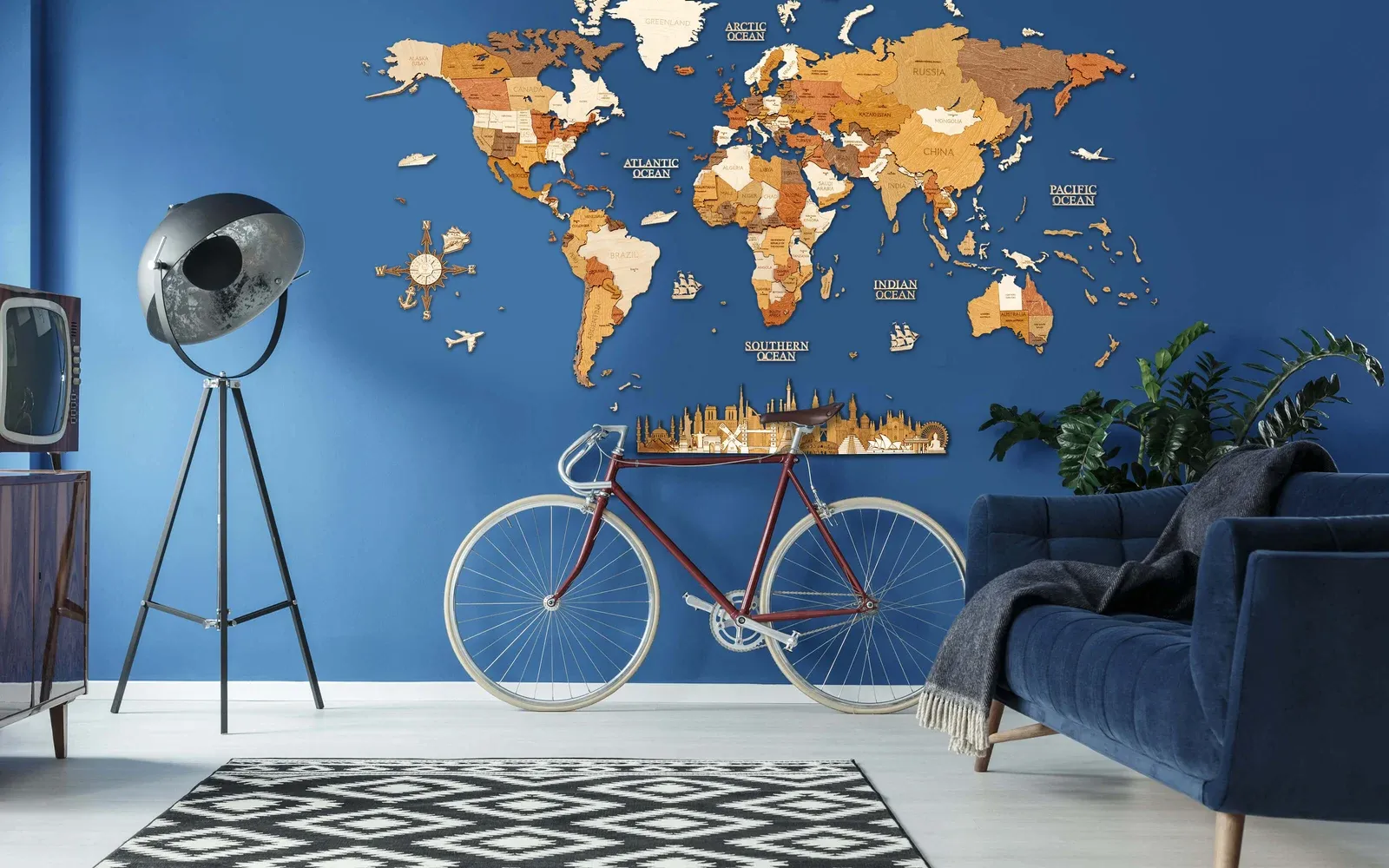
A map assembled from separate landmasses, with wood tones, visible edges and the wall showing between continents.
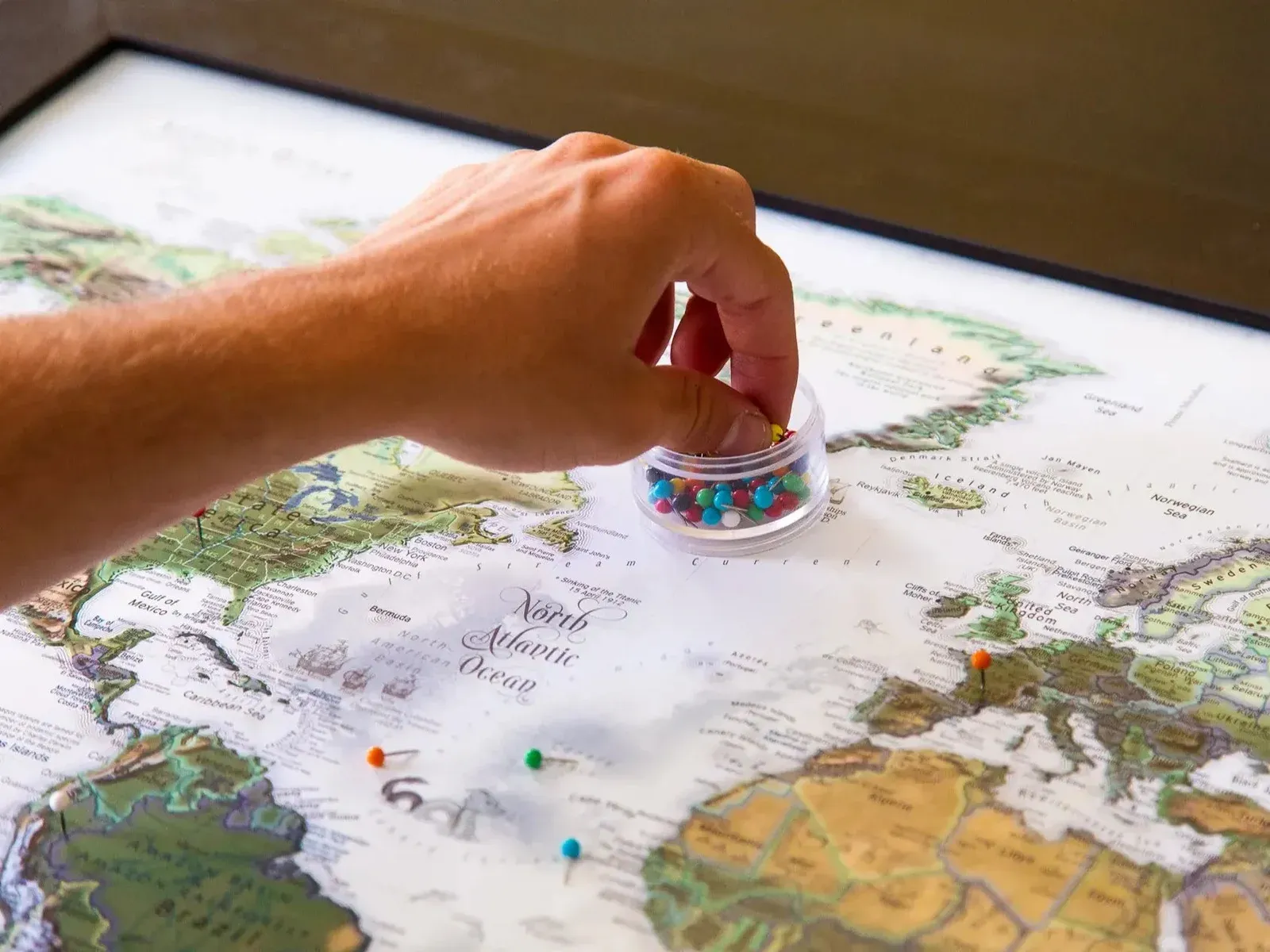
A printed map on a backing made for pins, with geography and legends on one continuous surface.
Manufacturer examples shown in different settings, not at a matched scale. Construction and included accessories vary by product.
The practical differences
Compare the display you will actually use.
| Decision | Wooden map | Push-pin map |
|---|---|---|
| Appearance | Separate wooden pieces add depth; detail varies by model. | Continuous printed geography; label readability varies with size. |
| Travel tracking | Use markers compatible with the selected map. | Pins mark places; backing is required. |
| Installation | Plan the layout; attach pieces with the supplied system. | Hang a finished board; rolled prints need mounting. |
| Display cost | Map, optional accessories, delivery and destination charges. | Print, backing, frame or wrap, pins and delivery. |
| Moving or changing | Move pieces individually; removal depends on wall and adhesive. | Move pins or the board; pinholes remain. |
| Care | Follow product instructions; comparative lifespan is untested. | Check backing thickness; repeated-pin wear is untested. |
Where wood makes sense
A display built around places.
- Wood gives each continent a physical outline against the wall.
- Engraved or printed geography can combine decoration and travel memories.
- Compatible accessory sets let you choose how much of the story to add.
The trade-offs
What to weigh before choosing.
- Not every wooden map supports pins or detailed city tracking.
- A dense collection of markers can obscure the geography on either format.
- Pin-map backing and marker compatibility need checking rather than assuming.
Compare the backing, not the word “pin”
GeoJango describes paper and canvas mounted on pinboard. The printed surface gives the map its appearance; the backing makes it suitable for pins. A rolled print with the same artwork is not automatically equivalent.
Ask the same question of wood. Does the maker recommend pins into the material, flags placed in specific positions or another attachment? Do not buy a marker set before verifying the answer.
Make room for the trips you have not taken
A legend can separate visited places, home and future destinations. Choose colors you can distinguish and assess crowded regions where several trips may land close together. A world map that looks clear across the room may not have the location detail you want when standing beside it.
This is a reason to inspect a geographic close-up, not just the room photograph. Paper and canvas can differ in how fine printing reads; wood products vary in labels, engraved borders and island coverage.
One board versus an assembled landscape
A framed or wrapped pinboard hangs as one object. Individual wooden pieces require a layout, while a wooden map on a backing can behave more like a board. Compare those actual constructions.
If pinning photos, tickets or souvenirs is central to your plan, check what the backing is designed to hold. A map that accepts small location pins is not necessarily intended to carry a collection of heavier objects.
Before you buy
Make the comparison specific to your wall.
- Inspect city-level detail in the regions you visit most.
- Confirm the backing, recommended pin length and included pin quantity.
- Choose a simple visited/planned legend before buying extra colors.
- Compare the full frame or backing footprint with the wooden layout.
How we compared these formats
We compared manufacturer descriptions, installation information and the pictured examples. The verdicts are editorial judgments for the stated use cases, not results of a controlled hands-on test. The table uses qualitative observations rather than a universal score.
Examples: 68travel 3D Wooden World Map; GeoJango paper/canvas maps mounted on pinboard. Prices, shipping, removal performance and longevity are not assumed to be equal across a category. Confirm the selected configuration before ordering.
Sources and research notes (2)
- Wooden World Map (opens in a new tab)68travel · Retrieved Sep 9, 2026Manufacturer documentation and real imagery for the named format or product; no independent hands-on testing, universal durability claims or verified landed-price comparison.
- Map Finish Options (opens in a new tab)GeoJango · Retrieved Sep 9, 2026Manufacturer documentation and real imagery for the named format or product; no independent hands-on testing, universal durability claims or verified landed-price comparison.