
Quick answer
Make the practical decisions first.
Construction matters more than the word “wooden.” Plywood is well suited to engraved, layered maps; HDF or MDF provides a smooth, consistent base for printed designs; real-wood veneer emphasizes authentic species and grain; and LED or magnetic systems add backings, spacing and mounting hardware. Compare the exact substrate, layer count, total depth, finish and fixing system - not just the product title.
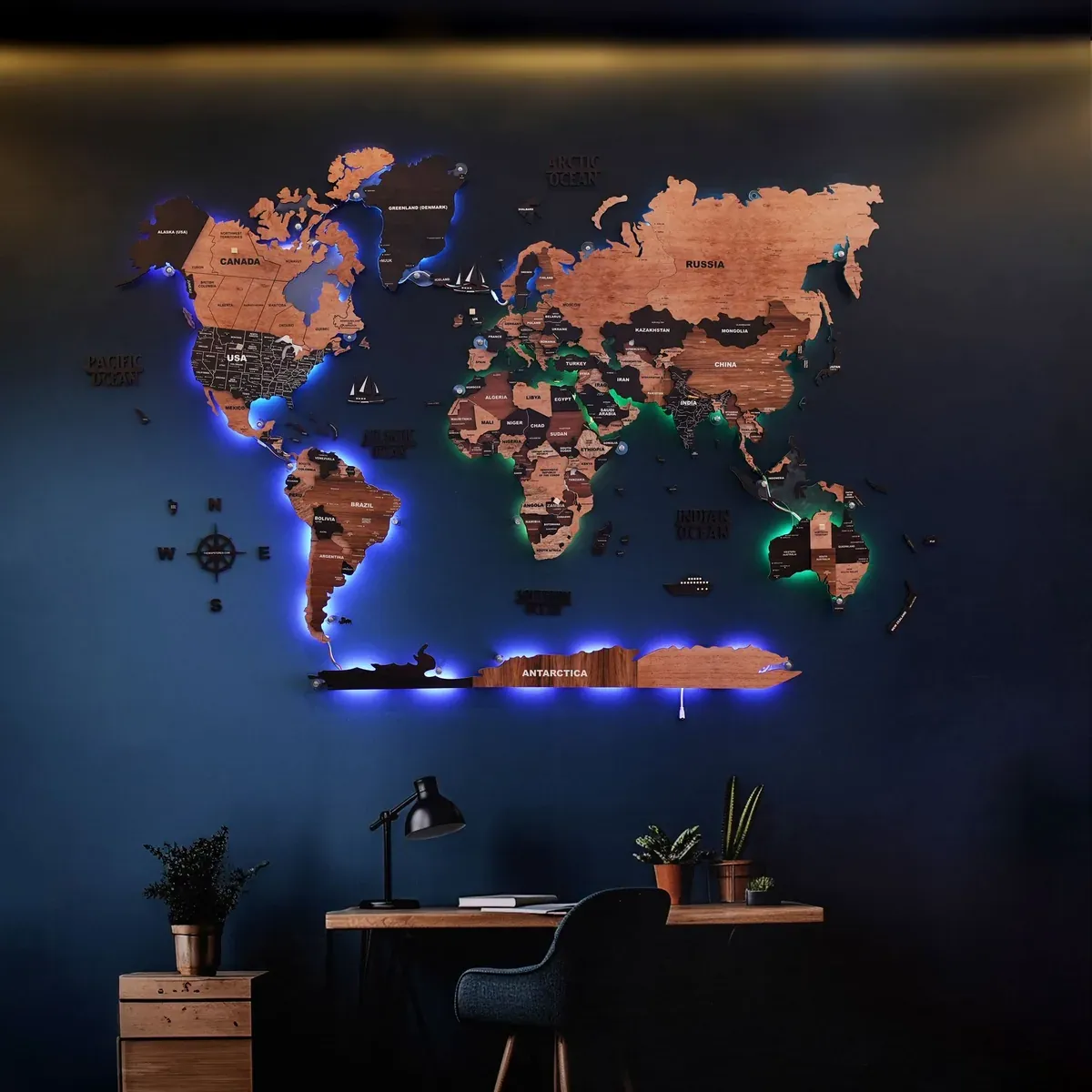
Compare visible materials and construction
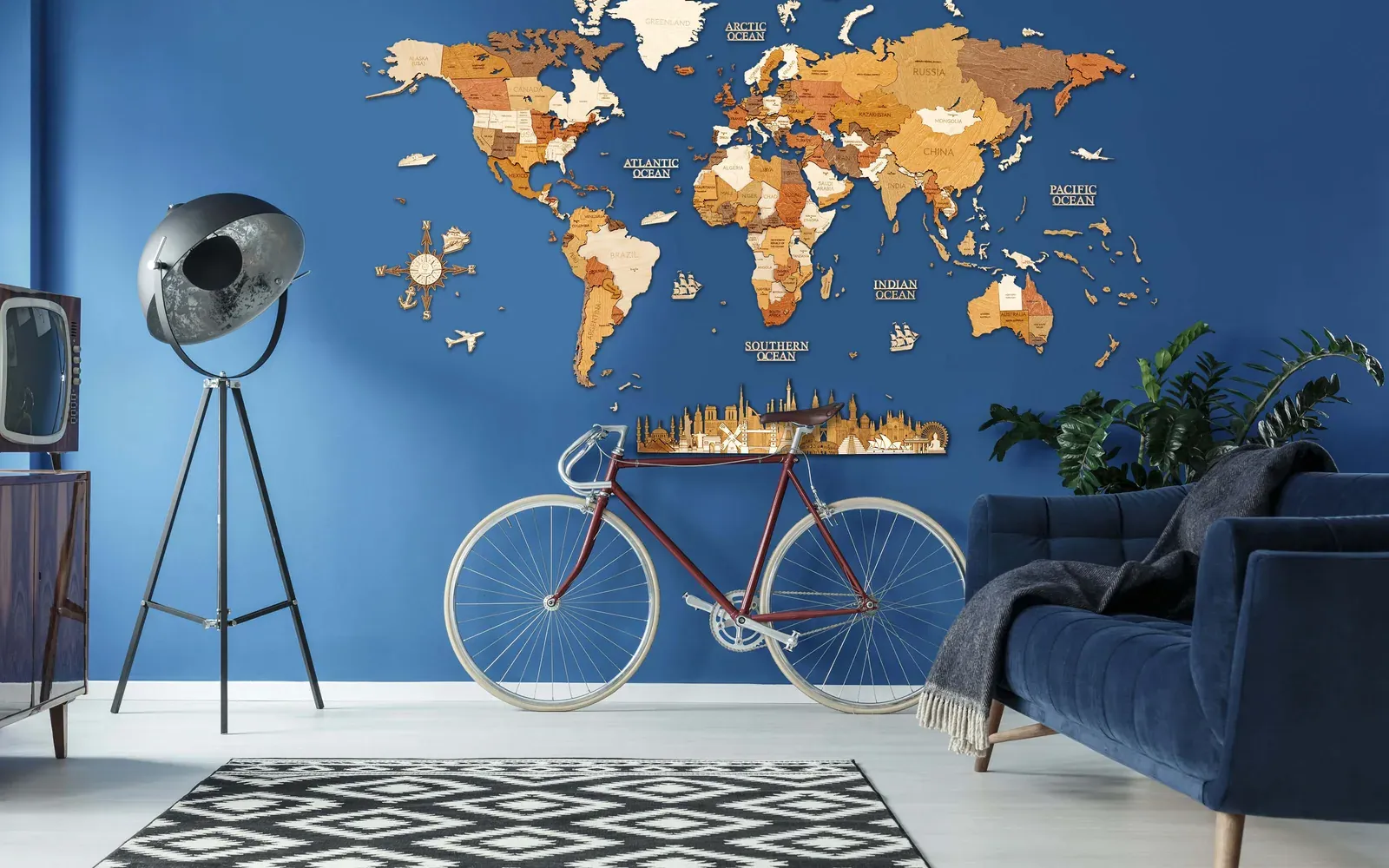
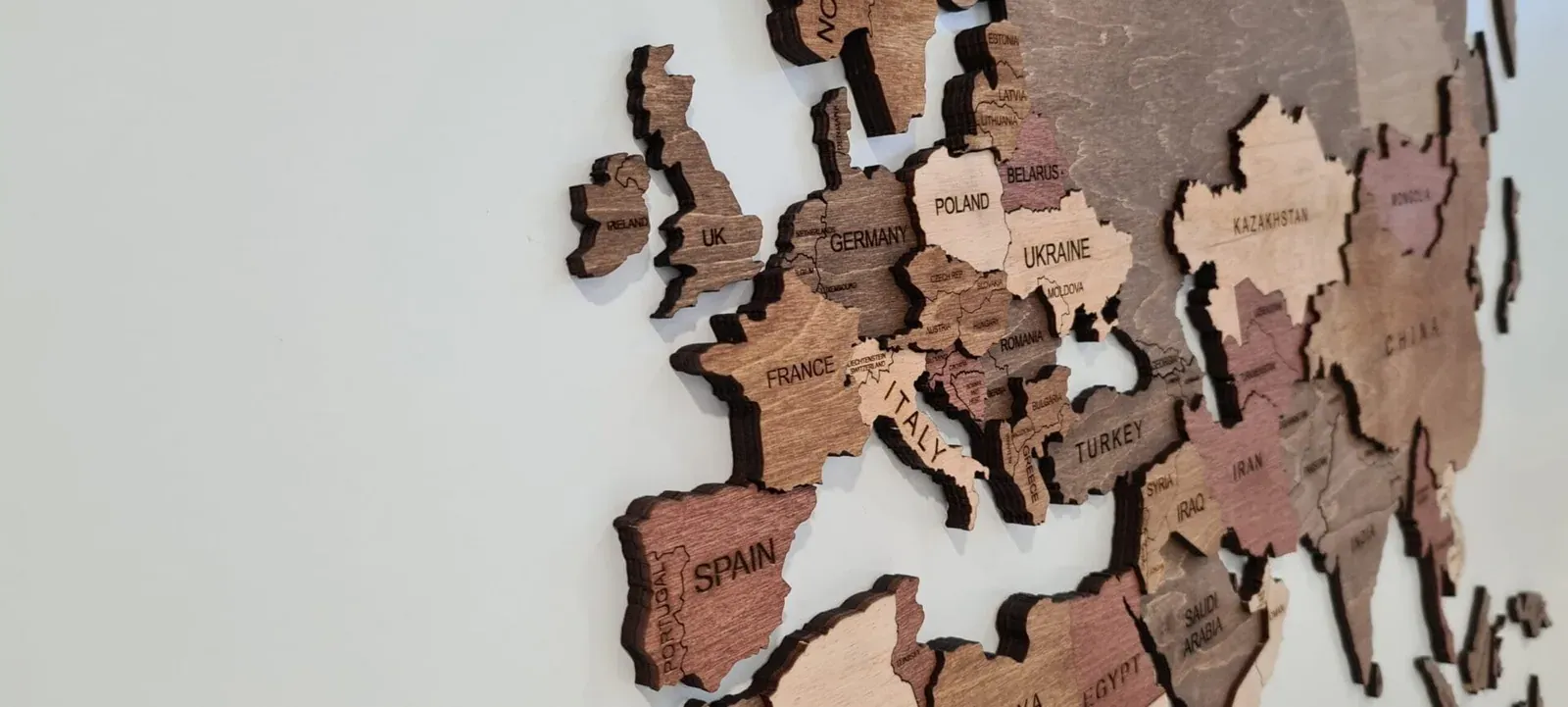
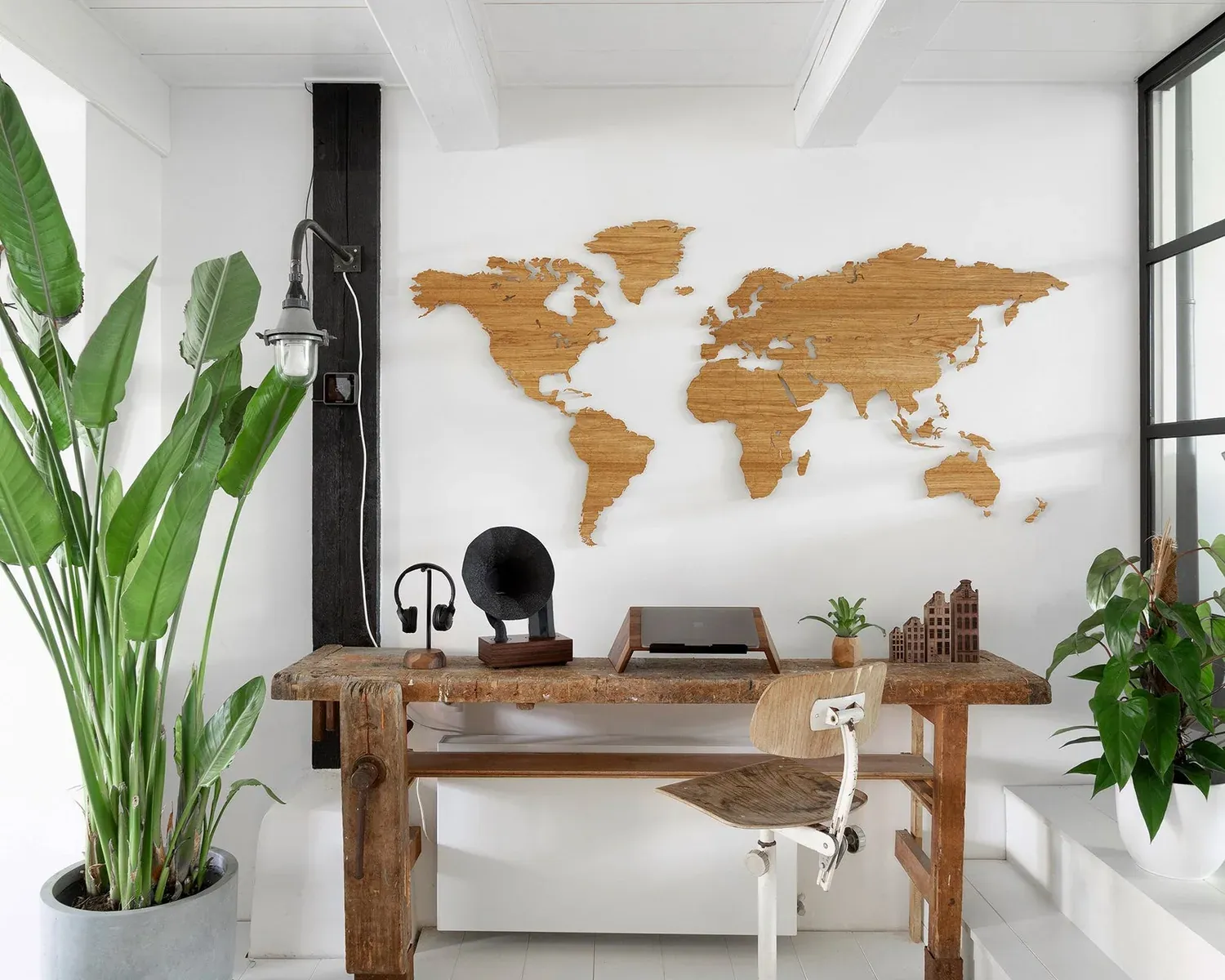
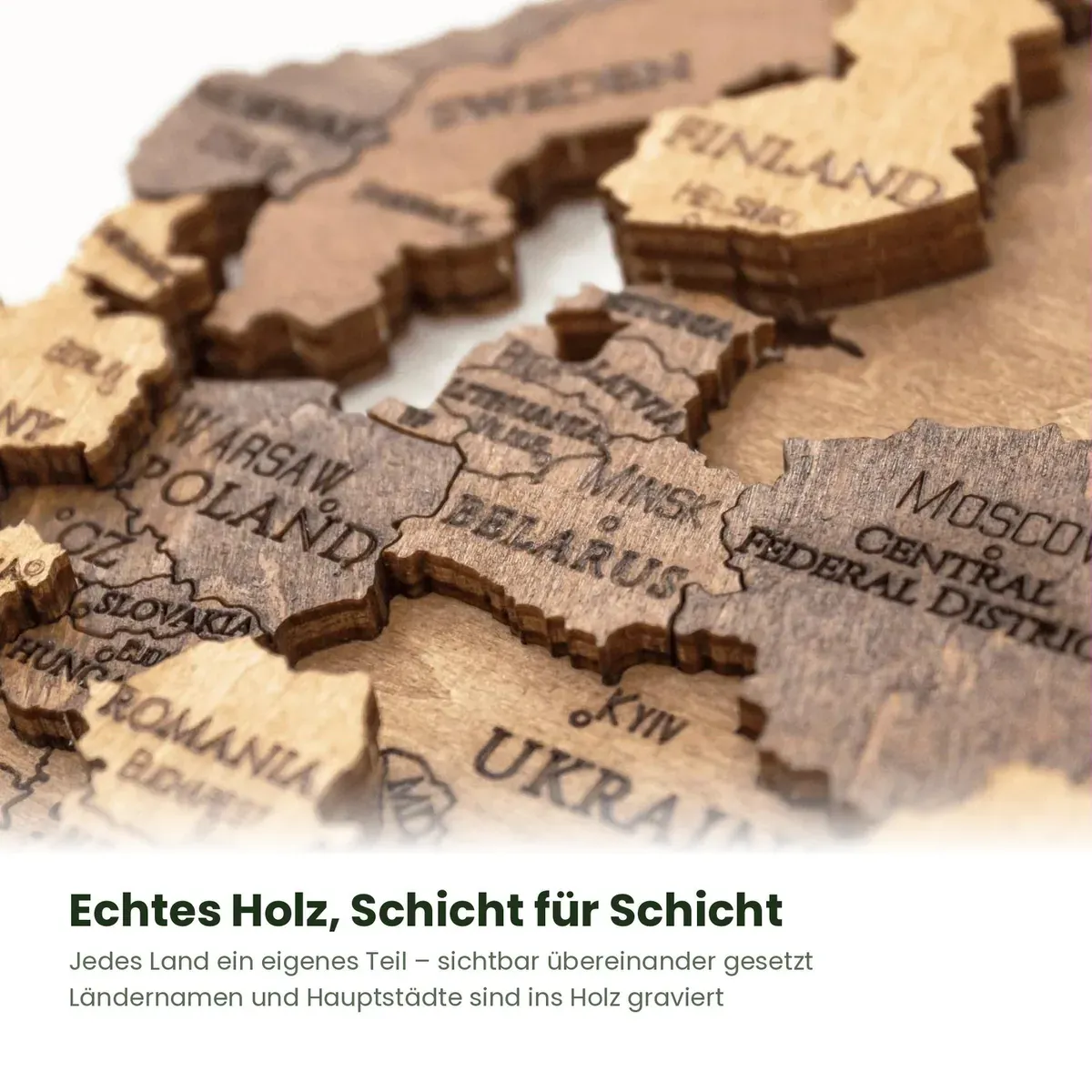
Start here
Your starting checklist.
- Separate the substrate from the surface finish and printed or engraved design.
- Layer count, board thickness and finished stand-off depth are different measurements.
- Printed colour and engraved relief solve different visual goals.
- Inspect close-up images of the exact size and edition you plan to buy.
- Let mounting construction and wall compatibility influence the material choice.
Start with the substrate, not the marketing name
Start with the effect you want to see every day: natural grain, readable printed geography or shadows between layers. Then inspect the surface, edge and backing of the exact map. Those views help connect a material name to the finished display; the product specification explains what the photograph cannot.
“Wooden map” covers several constructions. The main panel may be plywood, HDF or MDF, a veneered panel, or a combination of wood-based board with acrylic, metal or magnetic components. None is automatically best: each supports a different balance of natural grain, fine detail, colour consistency, depth, weight and installation method.
| Construction | Typical visual strength | Practical trade-off | Verify on the product page |
|---|---|---|---|
| Stained plywood | Grain, engraved detail and layered shadows | Natural variation means samples and screens cannot predict every panel exactly | Species or plywood type, layer count, panel thickness, finish and engraved features |
| Printed HDF or MDF | Smooth, repeatable colour and detailed printed geography | The printed face, not visible grain, usually provides most of the visual character | Board type, print process, surface protection and edge finish |
| Real-wood veneer on a stable panel | Recognizable species and a furniture-like surface | A thin real-wood face is not the same as a solid slab; backing construction matters | Veneer species, core material, total thickness and mounting system |
| Solid-wood elements | Strong material authenticity and distinctive grain | Movement, weight and variation can be greater, depending on piece size and construction | Actual solid-wood components, species, conditioning and attachment method |
| Mixed LED construction | Backlit depth and evening impact | Adds power, cable, stand-off and wall-fastener decisions | Wood-based panel, acrylic or metal backing, controls, depth and replaceability |
The wooden map buying guide is a useful example of why the distinction matters: its current families separate stained engraved plywood from UV-printed HDF and from LED constructions with additional backing and supports. Treat those as different product systems, not colour variants of one map.
Plywood: useful for engraving and layered relief
Plywood is made from bonded wood veneers with adjacent layers oriented to improve stability. For wall maps, its practical attractions are a visible wooden edge, compatibility with laser cutting and engraving, and the ability to stack panels or details into relief.
Plywood still varies. Ask what is actually observable:
- Is the face stained, painted, printed or left natural?
- Are borders, labels and terrain engraved, printed or separate pieces?
- How many structural and decorative layers are present?
- What is the thickness of one panel and the maximum finished depth?
- Are small islands separate wooden pieces, printed details or omitted at that size?
The current engraved 3D map emphasizes stained plywood, engraved cartographic detail and multiple relief layers. Your Wooden Map currently describes a birch-plywood construction with selectable detail levels, while WeLoveCut describes a two-layer product. These are useful comparison points, but the maker’s stated dimensions and materials should be checked for the exact variant before publication.
HDF and MDF: consistent bases for print and precision cutting
Medium-density and high-density fibreboards are engineered panels with a more uniform surface than visibly grained plywood. That consistency makes them useful when detailed UV printing, even colour and predictable cutting are more important than exposed natural grain.
The material name alone does not reveal quality. Compare:
- density and stated panel thickness;
- print resolution and whether geography or decoration is being printed;
- edge colour and finishing;
- surface resistance and cleaning instructions;
- backing, spacers and total installed depth.
The full-colour 3D map uses printed physical-geography styles on HDF. The Map Store’s LED product describes a pine-MDF construction with lighting components. They may both be fibreboard-based, yet their intended appearance and installed construction are substantially different.
Veneer and solid wood are not interchangeable
A real-wood veneer is a thin layer of a named wood species applied to a stable core. It can provide genuine oak, walnut or another species at a practical panel thickness. Solid wood means the relevant component is wood through its full thickness. Product copy sometimes uses “real wood,” “natural wood” and species names loosely, so confirm the layer structure rather than inferring it.
Wooden Amsterdam’s map is a useful differentiated example: it offers multiple wood veneers and a magnetic floating installation. That construction should be compared on veneer selection, panel/core build and removability - not scored as though it were trying to create the same deep engraved relief as a multilayer plywood map.
Wood responds to moisture. The USDA Forest Products Laboratory’s Wood Handbook documents moisture-related dimensional change in wood and wood-based products. For a finished wall map, follow the maker’s placement and care instructions, particularly around damp walls, strong heat sources and large humidity swings.
Printed colour, stain and engraving create different information
Surface treatment changes both style and what the map can communicate.
- Stain lets grain remain visible and can differentiate panels or regions, but natural variation remains part of the result.
- Paint or opaque colour offers stronger palette control and may reduce visible grain.
- UV printing can show physical geography, decorative patterns or vivid country colours at a level that stain alone cannot.
- Laser engraving adds labels, borders and linework through a tactile, usually restrained mark.
- Applied pieces create real shadows and relief, but very small geography becomes harder to manufacture and install.
Colorfull Worlds foregrounds vivid UV-printed decoration. 68travel’s printed HDF families foreground physical-geography styles, while its stained plywood families foreground grain and engraving. Judge the specific design intent: a more colourful map is not necessarily more geographically informative, and a more layered map is not necessarily easier to read from across a room.
Layer count, thickness and wall depth are three different facts
Marketing commonly compresses these into “3D.” Record them separately:
- Layer count - how many visible or structural levels make up the map.
- Panel thickness - how thick an individual cut component is.
- Installed depth - the maximum distance from the wall, including stacked panels, spacers, magnets, acrylic backs or lighting hardware.
This distinction prevents misleading tables. A two-layer map made from thicker board may project farther than a four-level design with thin decorative pieces. An LED map can have modest wooden relief yet a much larger installed depth because the lighting needs spacing.
Examine construction at the exact size
Do not assume that every size is a scaled copy. At smaller widths, names, narrow borders and island pieces may be reduced, grouped or omitted. At very large widths, panel seams, alignment, weight and the number of fixing points become more important.
Before choosing, inspect:
- a straight-on full product image for overall composition;
- close-ups of coastlines, borders, names and small islands;
- side views showing edge finish and actual depth;
- uninstalled pieces or package contents;
- the template, backing or magnetic system;
- customer photos only when the exact product and size can be identified.
Product imagery is evidence of visible design, not proof of hidden materials, durability or manufacturing origin. Those claims need specifications, instructions or another suitable source.
A sensible construction decision
Choose engraved plywood when natural grain, tactile detail and layered shadow are the priority. Choose printed HDF or MDF when consistent colour or detailed printed geography matters more. Choose real-wood veneer when named species and a furniture-like surface are central. Choose LED construction only when illumination justifies the additional power and mounting work. Choose a puzzle or DIY construction when assembly is part of the experience rather than an inconvenience.
After narrowing the construction, compare geographic detail, included pieces, the exact mounting system, wall compatibility, warranty and delivered price. Those practical differences usually matter more than a generic “premium wood” claim.
Last checked
Specifications and policies may change.Sources and research notes (15)
- Wooden Maps Buying Guide: Types, Sizes and Finishes (opens in a new tab)68travel · Retrieved Sep 5, 2026Overview of engraved, full-colour, LED and 2D wooden map families, plus size, finish, installation and accessory decisions.
- Engraved vs Full-Colour vs LED Wooden Maps (opens in a new tab)68travel · Retrieved Sep 5, 2026Manufacturer comparison of map materials, engraved and printed geographic detail, lighting, and intended wall effect.
- 3D Wooden World Map: Engraved Details, Islands and Mounting (opens in a new tab)68travel · Retrieved Sep 5, 2026Current engraved plywood map construction, layers, editions, available sizes and finishes, geographic details, included islands, accessories and mounting contents.
- Full-Colour 3D Wooden World Map: Printed Geography and Styles (opens in a new tab)68travel · Retrieved Sep 5, 2026Current HDF construction, UV-printed geographic detail, map styles, layers, available sizes, islands, accessories and mounting contents.
- LED Wooden World Map: Lighting, Layers and Installation (opens in a new tab)68travel · Retrieved Sep 5, 2026Current engraved LED map construction, wooden and acrylic layers, lighting controls, available sizes and finishes, accessories and supported installation approach.
- Full-Colour LED Wooden World Map: Printed Detail and Backlighting (opens in a new tab)68travel · Retrieved Sep 5, 2026Current full-colour LED construction, printed geographic styles, backlighting, controls, available sizes, accessories and supported installation approach.
- 2D Wooden World Map: Flat Layered Design and Details (opens in a new tab)68travel · Retrieved Sep 5, 2026Current flatter wooden map construction, profile, available sizes and finishes, engraved geography, included islands and mounting contents.
- Wooden World Map - 10 Woodtypes (opens in a new tab)Wooden Amsterdam · Retrieved Sep 5, 2026Real-wood veneer choices, panel construction, magnetic mounting system, dimensions, package contents and installation approach.
- 3D Wooden Map (opens in a new tab)Your Wooden Map · Retrieved Sep 5, 2026Birch-plywood construction, available sizes, cartographic detail tiers, colour choices, package contents and adhesive installation.
- 3D Wooden World Map - Grey (opens in a new tab)WeLoveCut · Retrieved Sep 5, 2026Layer count, stated thickness, material description, size options, included accessories and adhesive installation.
- Wooden World Map Wall Puzzle (opens in a new tab)MagicHolz · Retrieved Sep 5, 2026Eco-Wood-Art puzzle-map construction, assembly format, component count, dimensions and wall mounting.
- 3D Wooden World Map (opens in a new tab)Colorfull Worlds · Retrieved Sep 5, 2026Wood construction, UV-printed finishes, hand assembly, available visual styles, mounting approach and product imagery.
- LED Wooden World Map (opens in a new tab)The Map Store · Retrieved Sep 5, 2026Pine MDF construction, stated depth range, LED options, installation components and product imagery; manufacturer identity requires separate verification.
- GeoArte Wooden World Map (opens in a new tab)GeoArte · Retrieved Sep 5, 2026Available sizes, material and finish claims, included accessories, mounting supplies and installation positioning.
- Wood Handbook: Wood as an Engineering Material (opens in a new tab)USDA Forest Service, Forest Products Laboratory · Retrieved Sep 5, 2026Properties of solid wood and wood-based panel products, including moisture-related dimensional change.